
AC Star Rating and ISEER Explained: What Changed in 2026
Quick answer: The star rating on an AC comes from its ISEER number, which measures how much cooling it gives per unit of electricity across Indian summer temperatures. From 1 January 2026, BEE made every star band stricter, so a 2025 5-star AC is now labelled 4-star, a 2025 4-star is now 3-star, and so on. When comparing ACs, check the label year and compare ISEER numbers directly, not just the stars.
What the BEE label is
Every split AC sold in India must carry an energy label from the Bureau of Energy Efficiency (BEE), part of the Ministry of Power. It shows a star rating from 1 to 5. More stars means the AC uses less electricity for the same cooling.
What’s printed on the label
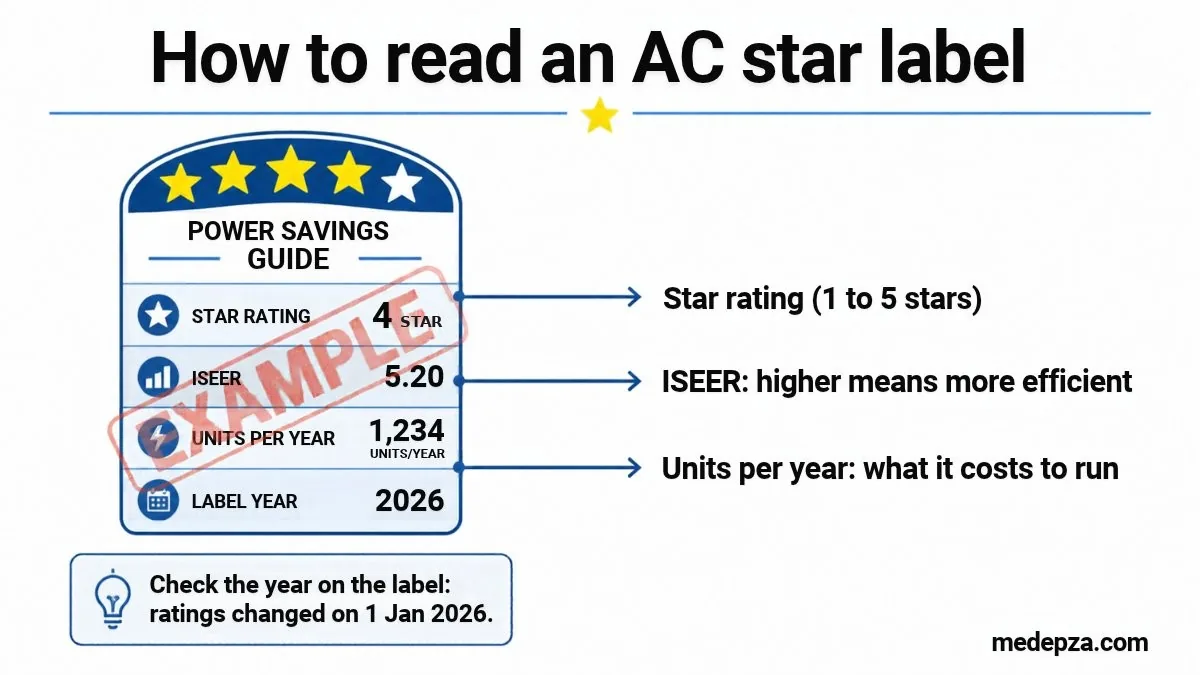
| Item on the label | What it tells you |
|---|---|
| Star rating (1 to 5) | Efficiency band under the current rules |
| ISEER | The efficiency number itself; higher is better |
| Annual energy consumption (units/year) | Electricity used in a standard year of use |
| Cooling capacity (W) | How much cooling the AC delivers, which shows its true size |
| Label period / year | Which year’s rules the rating was tested against |
| Brand and model | Check it matches the AC you’re buying |
The annual units figure assumes a standard amount of use, around 1,600 hours a year. Your real use may be more or less.
What ISEER means
ISEER stands for Indian Seasonal Energy Efficiency Ratio. Instead of testing an AC at one temperature, it measures performance across a range of outdoor temperatures from about 24°C to 47°C, reflecting a real Indian summer. That makes it more useful than older ratings that only tested at one fixed point.
In simple terms: an ISEER of 5.5 means the AC delivers 5.5 units of cooling for every unit of electricity it uses across a typical season. Higher is better.
What changed in January 2026
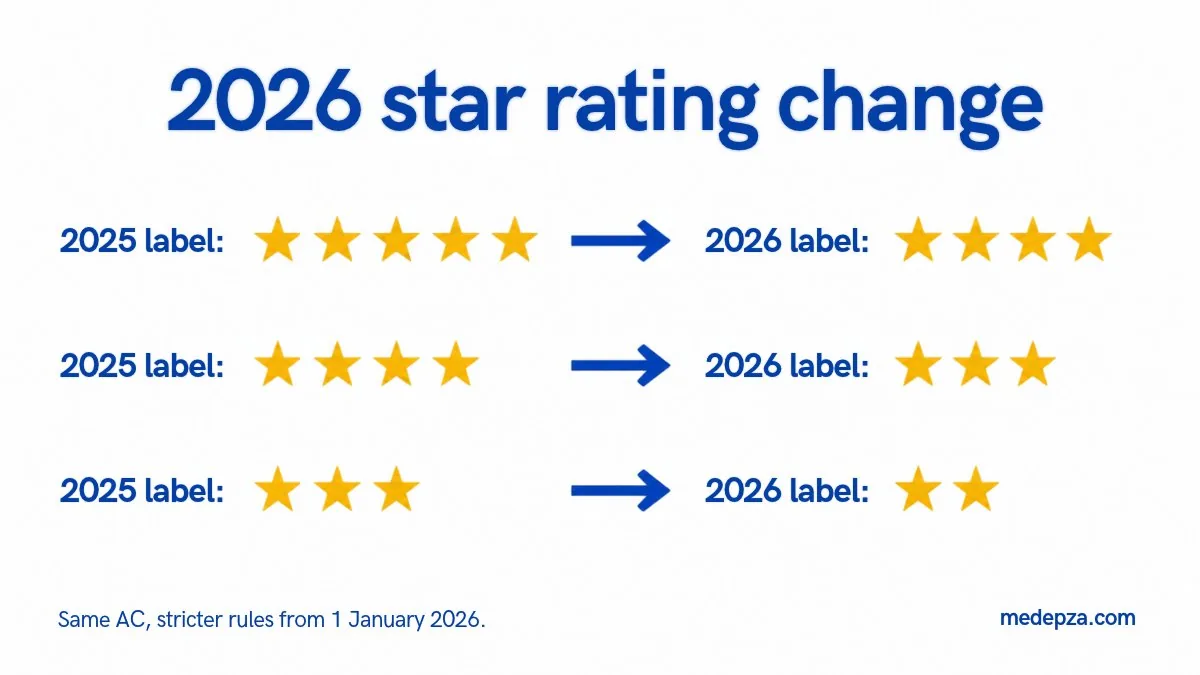
BEE revises the star bands every few years as technology improves. The 2026 revision tightened every band:
| 2025 label | Same efficiency under 2026 rules |
|---|---|
| 5 star | 4 star |
| 4 star | 3 star |
| 3 star | 2 star |
So a new 2026 3-star AC is roughly as efficient as a 2025 4-star, and a 2026 5-star is more efficient than any old 5-star. Industry reports said this made 5-star ACs around 5 to 10% more expensive in early 2026, because they need better parts to meet the new bar.
Recent 2026 5-star 1.5 ton models we’ve seen listed have ISEER ratings of about 5.6 to 5.8. That’s a useful benchmark when you shop.
Watch out for old stock
Shops and online sellers may still have ACs with older labels. A “5-star” sticker from 2024 or 2025 is not the same as a 2026 5-star. Always:
- Look for the label year or period on the listing or box.
- Compare the ISEER numbers, which don’t change with the rules.
- Ask the seller if you can’t find it.
Is a 5-star AC worth the extra money?
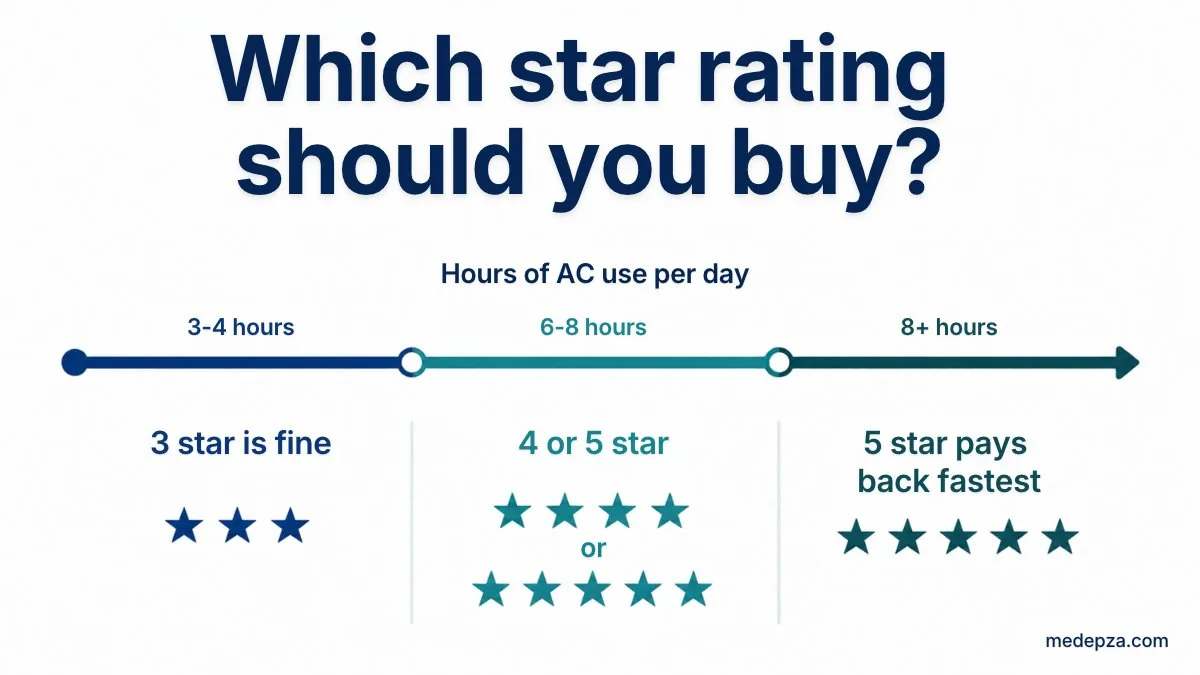
It depends on how much you use it.
| Your use | Better choice |
|---|---|
| 8+ hours a day, most of the year (hot regions, work from home) | 5 star |
| 6 to 8 hours a night through summer | 5 star or a high-ISEER 4 star |
| 3 to 4 hours a night, a few months a year | 3 star (2026 label) |
| Guest room, rarely used | 3 star |
A quick way to decide: take the price difference between the two models and divide it by your estimated yearly saving. If it pays back in four years or less, the higher rating is usually worth it, since ACs typically last 8 to 10 years.
Star ratings for window ACs
Window ACs have their own BEE label and star bands. Window and split ratings use different standards, so compare window ACs only with other window ACs.
Related guides
- Best 1 Ton AC in India (2026): Split and Window Picks for Small Rooms
- Best 1.5 Ton Split AC in India (2026): Inverter Picks Under the New BEE Ratings
- Best 2 Ton Split AC in India (2026): Picks for Large Rooms and Halls
Common questions
Is a 3-star AC bad in 2026?
No. Under the stricter rules, a 2026 3-star inverter AC is about as efficient as a 2025 4-star. It’s a sensible choice for moderate use.
Why did AC prices go up in 2026?
Partly because of the new BEE rules: meeting the higher bars needs better compressors and coils. Commodity and component costs also play a part.
Does star rating affect cooling power?
No. Star rating is about efficiency, not strength. Cooling power depends on tonnage and capacity. See what size AC you need.
Do all ACs need to show a star label?
Split and window room ACs sold in India must carry a BEE label. Always check it before buying.
The bottom line
Read the label, not the sticker. Check the year, compare ISEER, and pick 5-star only if you’ll run the AC for long hours. And if you’re still choosing a type, see inverter vs non-inverter ACs.